
There was a time, not too many years ago, when anxiety was my constant companion, nay-sayer, punisher, and fear monger.
I would spend weeks dreading a phone call I had to make.
I’d put off replying to emails for so long that it got extra weird to reply, and the anxiety compounded.
I’d start projects, and get overwhelmed by all the things that needed to happen in order to make progress, and shut down, and emotionally beat myself up about it. And then get irritable, and say the wrong thing to someone, and have something else to ruminate about.
Things that other people consider simple, like cooking, cleaning up, making an appointment, or deciding whether I wanted to go to an event with people (and how), felt so overwhelming, and even thinking about them triggered so much anxiety I’d often do something else instead…or shut down.
I’d avoid grocery shopping until my kitchen looked like Mother Hubbard’s cupboards.

Do you spend weeks putting off phone calls? Or avoid replying to emails for so long that it gets extra weird, and then it’s even harder to do it? Do you start projects, get overwhelmed by all the steps, shut down, and then emotionally beat yourself up about how you never finish anything, and can’t follow through, and what’s wrong with you, everyone else manages this?
Maybe things that other people consider simple—like cooking, cleaning up, making an appointment, deciding whether you want to go to an event—feel so overwhelming that even thinking about them triggers so much anxiety, you spend hours on your phone, or binge Netflix, or do everything else on your to do list but the thing that you really need to do.
What if you had skills to dissolve these anxieties when they come up? That actually work for our Autistic and AuDHD brains. Not make them magically disappear forever—let’s be realistic—but reduce their intensity, so they’re not as overwhelming? So your brain has capacity left over to think other things, like finding actual solutions to the real situations you’re dealing with?
Hi, this is Heather from Autism Chrysalis. And here’s the thing. If you’re Autistic or AuDHD, you probably struggle with anxiety in ways that other people just don’t get. Maybe you’ve been accused of procrastinating, being a perfectionist, overthinking, or being lazy. Maybe you’ve heard this so often you’ve internalized these messages and accused yourself of the same things.
But I don’t believe any of that. Well, to be fair, sometimes I do want things to be just so, because there’s a good reason for it, and I can think through a lot of the potential issues with something in advance, and sometimes my energy is low, but those are actually different things than what I’ve been accused of. And it’s not just making it sound better, there is a real difference.
The way I see it, there’s always a legitimate reason why you’re not doing something. Sometimes it’s because you have a history of genuinely bad experiences that you’re trying to avoid the pitfalls of. Or you don’t know how to deal with very real problems, and it’s so easy to focus on those, and everything else that could go wrong.
And even when you intellectually know that most of these worries probably won’t happen this time, it’s not so easy to turn off the scenes of disaster playing on endless loop in your head, or the clenching in your gut, or to fall asleep with your mind on overdrive.
The usual advice? “Just let it go.” “Try harder.” “Take a few deep breaths.” Has any of that actually helped you? It never did anything for me.
Talking yourself out of ruminating doesn’t work. Forcing yourself to do things only works for a while, then the resistance grows stronger. Tips for procrastination don’t work, because it’s not really that. And reframing anxieties doesn’t get at the real issue when you have many real experiences of what you’re anxious about coming true.
Can I take a moment to acknowledge that this really is hard?
But you’re NOT broken, or defective, and there’s nothing wrong with your brain.
That’s why I created Anxiety Reduction for Autistics. This is a four-module course—that was originally presented live over four weeks—and is now available to you right now, on demand.
It’s designed to help you learn real skills that are neurodivergent-friendly to reduce anxiety, both the practical, immediate overwhelm, and then how to deconstruct the underlying thought patterns that keep the rumination going, and the guilt, and shame, and negative self-talk.
I’ve been through that myself. I’m Autistic and AuDHD, and lived with moderate to severe anxiety most of my life, until I figured out this framework several years ago. At times the anxiety was so intense that I barely left my house for months or years at a time. The phone taunted me. Having one thing planned meant the whole day was shot. Or the whole week, when it was really bad. I canceled at the last minute so often that I lost friends.
But now? I can deal with last minute changes. I don’t love them, but I can deal with them. I can have difficult conversations and not ruminate for ages when I say something awkward. I can deal with sensory stuff better. I can ask for what I need without my anxiety spiking. I can have a technician come to my house to fix something, and not spend the week beforehand, dreading it. And so much more.
It’s often little day-to-day things, but those add up to real, positive improvements in my life.
This is the same framework, and the same techniques, that I teach my private coaching clients, distilled down to their essence, in a systematic way that’s easy to understand and put into practice in the real life circumstances you’re dealing with.
Okay, so what’s actually covered in this course?
1. A framework for understanding anxiety that doesn’t blame or shame you, that doesn’t assume you’re broken or that something’s wrong with you for having anxiety. I make a distinction between the pain of the actual stuff you’ve gone through—the actual traumas, the actual circumstances—and the extra layer of pain that comes from how you’re thinking about those situations. Because that extra layer is where anxiety comes from, and that’s what we can work with.
2. How to tell which part of your pain is from external circumstances, and which part is made worse by how you’re thinking about it. This is tricky, because there’s at least some truth in how you’re thinking, or it’s close enough to the truth that it feels true—you’re not worrying for no good reason. But picking this apart is what I’m good at, and this is what I’d like to show you how to do.
3. Eight practical techniques to deal with those painful thoughts and reduce anxiety. These are the ones that consistently get the best results for my Autistic, ADHD, and highly sensitive clients. They’re not all going to appeal to you, and that’s your failure, or a failure of the curriculum; I don’t actually expect you to like all eight. Because I’m providing a wide enough variety so that everyone will resonate with at least one or two. Because if even one or two are helpful, and you use them, even intermittently, it can make a big difference over time.
4. Each module starts with a physical anti-anxiety technique to help you soothe your nervous system, because we’re doing something that’s unfamiliar and it’s OK for that to feel weird, or to be nervous about that. So we’re going to do a little work regulating the nervous system so that you can take in what’s presented in the rest of the class. That way you get a new technique, and get to experience it working in a real scenario. Then we’ll get into some theory—why anxiety works the way it does, and why these techniques work—and then we’ll put that theory into practice with another technique. There’s Q&A time afterwards, with real questions and examples from other Autistic and AuDHDers, modeling how to put this into practice in your own life.
5. Real examples from an Autistic and AuDHD perspective. This isn’t just abstract theory, or just a few tips and tricks—it’s the combo of understanding what’s going on, and practical tools that actually work for neurodivergent brains, and why they work, from someone who has lived this and worked with hundreds of Autistic adults and teenagers.
Now, I want to be honest with you.
Will this course completely eliminate your anxiety? No. And I wouldn’t trust any short course that makes that promise.
Your anxiety probably developed gradually over a long period of time. And it’s had a lot of practice doing what it’s doing—trying to protect you in the only way it knows how. A few weeks isn’t going to change all of that. That’s not realistic.
But it can make a real difference. Because, when even one or two of these techniques work for you, and use them, at first, once in a while, inconsistently, when you remember, that will give you genuine experiences that you can deal with the anxiety of doing or saying difficult things. And that will generate a small amount of tentative cautious optimism, that it might be possible for other things.
Then you try it with those, and find out that you can deal with those hard things too. Even if it doesn’t always turn out the way you want, you can deal with it, however it turns out. And this creates an upward spiral of success, and you build trust in yourself that you can deal with hard things. And uncomfortable things. And that you can break old patterns.
And you start using this with harder and harder anxieties, and harder circumstances, and that can make a big difference over time. This is what got me from spending an hour wandering the supermarket aimlessly because I couldn’t couldn’t find something and couldn’t bring myself to ask a random stranger (who worked there) where it was, to asking, to taking other risks in my life, speaking up at the doctor, replying to an old text message, and all the other little steps that it took to make my life what it is now.
And just 20 minutes before I recorded this, I wrote a really difficult email to someone, out of the blue, that was really hard for me and is risking a lot, but I’m trusting that it’ll be OK. And I know I will be OK, no matter how they react. And I can deal with the anxiety enough to send the email, and I can deal with the anxiety of waiting for a response, before knowing how it’s going to go over. And I can do this, do something else, while I’m waiting for that response. It doesn’t consume my entire life anymore.
This is how it makes a real change in your life, one little bit at a time. Working with the other things that you’re already doing.
Although worries and fears may always come up, that’s life, they won’t be paralyzing anymore. Because you’ll trust yourself that you can deal with them. Because you’ll have experience dealing with them.
Okay, here’s the details:
This is the recorded version of the last time I presented this live in 2025, so you get all four modules as video recordings, an audio-only version, complete transcripts with the slides included, all the slides separately, and all the handouts, worksheets, and bonuses.
Because it’s recorded, you have the freedom to follow along at your own pace. Rewind and rewatch as much as needed. Engage on your own schedule, as your energy allows. With no pressure to show up on someone else’s schedule or feel guilty about missing live meetings. And you can come back months later for a refresher.
You’ll have access for at least a full year, guaranteed, and probably several years. I don’t want to promise “lifetime access”—whose lifetime, yours or mine? Or the lifetime of the website, and how long is that? This is where my mind could get into anxiety spirals, but I’m not going to go there—but I intend to keep this available for the foreseeable future.
This is an inclusive, trauma-sensitive, and BS-free zone. All are welcome, including LGBTQIA+ humans and all gender identities.
And while this course is designed from and for an Autistic and AuDHD perspective, if you’re not Autistic but my approach resonates with you—maybe you’re a highly sensitive person, or neurodivergent in other ways, or questioning whether or not you might be autistic—you’re welcome here too.
And here’s my promise to you: If you give this framework a fair try, try the techniques, implement what’s presented, find and question your painful thoughts, and don’t notice any reduction in your anxiety within six weeks of enrolling, let me know and I’ll refund your money in full. Basically, if you sign up and don’t use the course, that’s on you. But if you give it a fair shot and it doesn’t actually help you, that’s on me. Is that fair?
So, here’s my invitation.
If you’re tired of anxiety keeping you from things that you want to do. If you want tools that actually work for your Autistic or AuDHD brain. If you want to understand why you feel this way and what to do about it, this course might be a fit for you.
For more info, and to sign up, go to AutismChrysalis.com/anxiety.
Because you deserve to have skills to manage anxiety. Because it’s okay to need help with this. And it is genuinely possible to make your life more functional and less overwhelming.
If this sounds like what you’re looking for, I’d love to share this framework with you.
Wishing you a neurowonderful day.

When I had something scheduled, like an appointment, or a repair tech coming over, or a package to be delivered, I would spend all day on tenterhooks, waiting for that time, unable to do anything else, even when it was hours away.
When I was working, I was constantly afraid of what other people were thinking about me. Did I say something wrong? What did that comment mean? Why didn’t she ask me about that project? What if she does? What should I say? What are they thinking about me? Am I about to be fired? What if the next round of layoffs gets me, and I can’t get another job?
And I’d compare myself endlessly to where I thought I “should” be at that point in my career, to how many different tasks other people could juggle, or how much they made, or how much they could do after work, and wonder what was wrong with me, and why could everyone else manage so much better than I could?
And when I did get praise, it was often because I was ridiculously good at certain things other people found hard, not because I felt like they liked me or wanted me around. So I still felt in danger all the time.
Job hunting was a minefield of anxieties: what if I get into another awful situation? Is it always going to be as bad as my last job? What if I never find a job that will work for my sensory needs? Is that even possible? Am I too old? Is it too late for me? I can’t start all over at this point in life.
I wanted to make things better, now that I understood I’m Autistic, and how I worked, but every fleeting desire to do something else, or to make a better life for myself, to get another job, to make anything better, was immediately followed by a barrage of negative thoughts, often about how weak/broken/bad I was, how the world would never work for me, and how it’ll never get any better, so what’s the point in trying.
I lived like this for so long that I forgot it could be any other way.

Even something as supposedly innocent and minor as catching up with a friend (what will they think of me for not being in touch for so long???) would overwhelm me, I’d shutdown, put it off, do something else, or do nothing, or else rant about how the world is screwed up, and then fantasize about moving to a cabin in the woods. Wouldn’t that solve everything???
Is any of this familiar to you?
And now, on top of all that, in our current political climate, with everything that’s going wrong in the world, there is so much more to provoke anxiety.
And yet, as shocking as this may seem, I’m not all that anxious anymore.
The anxiety isn’t gone, but there’s not much left, and it’s not very strong, and the negative voices aren’t very loud, and what is left is very manageable.
And I now have the skills to manage it when it does come up.
It took me a long time to get to this point. Gradually, bit by bit, I figured out what worked to really get at the root of it, and to deal with it better.
And I’d like to share with you what worked. So you don’t have to reinvent the process on your own. So it won’t take nearly as long.
From an Autistic/ADHD perspective, as an AuDHD human who has been through the anxiety minefield.
What if you had skills to deal with these kinds of situations when they come up? I won’t promise they will go away forever (let’s be realistic), but I firmly believe (and have experienced) that it is possible to learn how to diffuse them so that they aren’t as intense.
And when they’re not as intense, they’re not as overwhelming.
So your brain will have capacity left over to think other things, like finding useful solutions to the real situations you’re dealing with.
In fact, that’s entirely reasonable. And possible. Even for your wonderfully Autistic or AuDHD self.
My anxiety is much more manageable now, which means my entire life is much more functional. For example…
I can speak up and ask for clarification when I need it. I can say no when I need to. Or back out of a commitment when that’s appropriate.
I can change my mind.
When someone doesn’t return an email or text promptly, I don’t immediately spiral into assuming they’re mad at me and that everything will be awful or awkward from now on, or that our relationship is over.
I can break down tasks into smaller steps, and not get overwhelmed at looking at all the many steps that need to get done, or get stymied by my need to complete everything or else it’s not worth doing anything.

When I need to get things done in a short time-frame, even unfamiliar stuff. And I can deal with the anxiety spike that still comes (it’s not nearly as bad), and I have the skills to short-circuit it so it’s short lived, goes away, and I can actually do the thing.
I can even manage the anxiety that swells up before telling someone I’m Autistic, so I can follow through, when I choose to. And with the anxiety so much lower, my brain can think of better words to say. And I can manage my own reactions to however they react to it.
And when someone criticizes me, or complains, or ghosts me, and I didn’t do anything objectively hurtful or bad, I don’t go into a negativity spiral like I used to. It’s not fun, but it genuinely doesn’t hurt me the way it used to. And I know deep down that I’m going to be okay.
The bottom line is that I trust myself and my ability to deal with hard things so much more, and I trust that I’ll be okay in life, no matter what happens.
What I’d like to share with you is HOW I got to this point. As an AuDHDer. Interested?
Overthinking isn’t combated by thinking your way out (if only!) or just thinking less (hah!).
Most people just look at what you’re doing (or not doing), and they make unkind assumptions.
I’m guessing people have accused you of procrastinating, being a perfectionist, overthinking, or being lazy.
Maybe you’ve heard this so often, from so many people, you’ve internalized these messages and have even accused yourself of these things. (I don’t believe any of them, by the way.)
And while yes, okay, you aren’t taking action, I don’t think its for the reasons people assume.
I’d like to offer a non-judgmental, non-shaming way of looking at what’s been going on.
The way I see it, there is always a legitimate reason you’re not doing something.
Sometimes its because you have a history of genuinely bad experiences with situations like these and you’re trying to avoid all the potential pitfalls.
Or else don’t have a clue how to avoid the very real dangers, and it’s so easy to focus on those, and everything else that genuinely could go wrong.
And even when you intellectually know that most of those worries probably won’t happen this time, it’s not so easy to turn off the scenes of disaster playing on endless loop in your head, or the clenching in your gut, or to fall asleep with your mind on overdrive.
And the advice to just “let it go” is sooo not helpful. How exactly do you do that???
Talking yourself out of ruminating doesn’t work.
Forcing yourself to do things only works for a while, then the resistance grows stronger.
“Try harder” is crap advice. You’ve tried with every ounce of your being. There isn’t any energy left.
Tips for procrastination don’t work, because it’s not really that.
Overthinking isn’t combated by thinking your way out (if only!) or just thinking less (hah!).
Reframing anxieties doesn’t get at the real issue when you have so many real experiences of what you’re anxious about coming true.
And allistics just don’t get it.

Can I take a moment to acknowledge that this really is hard. So damn hard.
There. I said it. And it’s true.
But you’re NOT broken, or defective, and there’s nothing wrong with your brain.
It makes sense to avoid things that have hurt you and might hurt you again.
Also, you’re not the only one struggling like this.
The way I see it, there are two sources of pain.
There’s the bad/awful/unwanted things that happen to us. These really do suck, and the pain from them is real. I’m never going to try to say (or imply) that this stuff wasn’t as bad as it really was.
And then there’s the pain (and it is real pain) that comes from how you think about the bad thing that happened. This is the part I want to address.
But here’s where it gets tricky.
Because that extra layer of pain on top of the original painful circumstance is where anxiety comes from.
So often, people (well-meaning friends and family, therapists, CBT practitioners, etc.) confuse the two.
And that’s where you get gaslit, or told it’s just “in your head,” or “it would all be better if you just thought about it differently,” or other crap like that.
And sometimes it can feel like they’re saying that you earned this, or that you deserve it (I don’t believe either of those), and that you’re the problem, and you just need to fix how you think about it and it’ll all be fine (I don’t believe any of that, either).
I want to be clear that I’M NOT SAYING THAT.
I want to be nuanced about this.
Because I am talking about thoughts, and what I call “thought work,” but here’s where I part ways with the others.
I make a distinction between the pain of the actual stuff that you’ve gone through, the actual traumas, the actual health issues, the actual friendship breakups, the abuse, etc…these are real circumstances.
The pain here doesn’t come from how you think about it.
This isn’t you making anything up.
And then there’s another layer, which is how you think about the situation that really did happen. And this can make it feel even worse.
This is also real, genuine pain, but it’s created by how we’re thinking about it.
This is the part I work with.
Because that extra layer of pain on top of the original painful circumstance is where anxiety comes from.
Plus, it creates more and more stress, and our brains don’t respond to that much stress very well, so it becomes harder to deal with the actual circumstances that you need to deal with.
I make a distinction between the pain of the actual stuff that you've gone through...and how you think about the situation that really did happen. This can make it feel even worse.
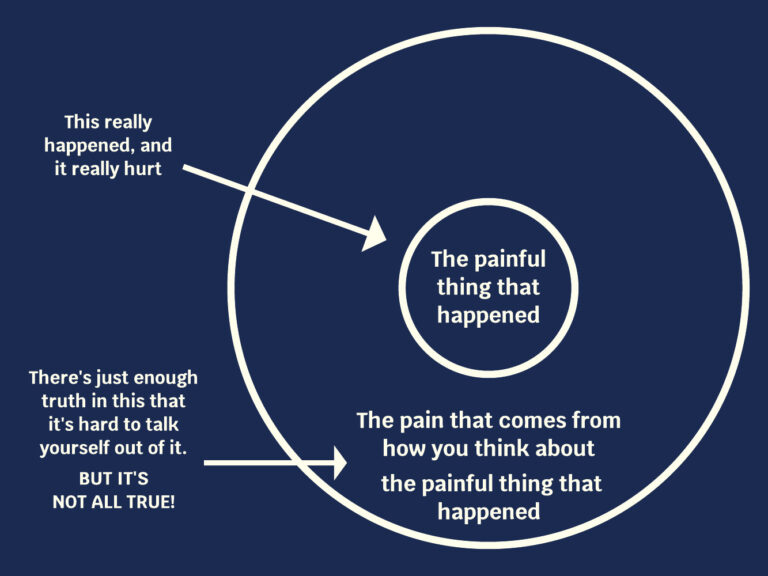
The tricky part is, that its often hard to tell which is the pain from the external circumstances, and which is about how we’re thinking about it.
Because there is at least a little bit of truth in how we’re thinking of it. You have genuine experiences that provide evidence that there is some truth in it.
You’re not thinking these thoughts for no good reason.
This is what I'm good at. And this is what I'd like to show you how to do.
If it were entirely false, you would be able to easily prove that and talk yourself out of it. It would be counter to your genuine reality.
And this is where I think a lot of therapists and CBT practitioners and well-meaning people get confused.
It really is hard sometimes to tell which part is true, and which part is the anxiety making it far worse than it needs to be.
But this is what I’m good at. And this is what I’d like to show you how to do.
And then, when you can tell which is which, what do you do with the extra pain?
That’s just as important, and I’d love to share several ways to deal with those painful thoughts, too.
What if you could figure out what parts are the external, practical sources of pain, and what parts are made worse by how you’re thinking about it, and could toggle between those?
Although worries and fears may always come up, they won’t be paralyzing anymore. Because you'll trust you can deal with them.
What if you had skills to diffuse these painful thoughts when they come up? I won’t promise they will go away forever (let’s be realistic), but it is possible to learn how to reduce their intensity.
And when they’re not as intense, they’re not as overwhelming.
So your brain will have capacity left over to think other things, and find genuine solutions to those real, practical problems.
That’s when practical anti-anxiety techniques and tricks, like breathing (and I’ve got a bunch of others), are most helpful, to deal with the leftover anxiety enough that you can put into practice the solutions you’ve figured out.
As you do, and experience neutral or positive results, over time that will rewire your nervous system to trust that you have new skills and abilities to deal with hard things.
As you deal with more hard things, and learn more skills, and your nervous system trusts that you can do hard things, more and more, the anxieties will gradually fade.
Although worries and fears may always come up, they won’t be paralyzing anymore. Because you’ll trust you can deal with them.
Because you can deal with them.

I know this, because I’ve lived it.
You see, I’m Autistic and ADHD, and struggled with anxiety (and depression, and burnout, and medical stuff, and complex trauma, and and and…) for decades.
At times it was so intense that I barely left my house for months or years at a time. The phone taunted me. Having one thing planned in a day (week) meant the whole day (week) was shot. I canceled at the last minute so often that I lost friends, and endangered relationships with others. Work took all my energy and thoughts, until it sapped my strength so much I couldn’t work at all.
There were times where it wasn’t that bad, where I managed to work or be nominally functional for a while, and sometimes I even got a lot done, but I still felt like I was barely holding on by my teeth.
I was fighting myself to get things done, forcing myself into things. Negative self-talk and ruminating thoughts plagued me. And it didn’t look like things would ever get much better. Not for me.
The mental framework and practical techniques that I’d like to share with you weren’t the only things that brought me out of that, but they were an important part of the mix, and I continue to use them on a daily basis to get through the many small and large difficulties of life.
For the past five years, I’ve been sharing them with my coaching clients, who consistently find them just as life-transforming, and I’m excited to share them with you.
The first 18 times was to over 190 neurodivergent teenagers, with 100% 5-star reviews!
But people kept asking me to offer a version for adults.
So I offered this to Autistic and ND adults in 2023, 2024, and 2005, and got very positive feedback! (The testimonials on this page are all from these participants.)
What you’re getting is the recorded version of the last time I presented this live. And this was the best one!
I used my best explanations, my best examples, the best info, and it included a lovely cohort who asked great questions.
I am proud to make this available as a recorded version, that you can now access anytime.
I'd like to offer a way to think about anxiety that doesn't blame or shame you, that doesn't assume you're broken or that something's wrong with you for having anxiety, or for the impact it's had on your life.
I’m the kind of person who needs to understand why something works.
So, over a few years, as I was coaching and teaching these techniques to my clients, and seeing the very real results in their lives, I thought through what made this stuff so powerful. And I think I’ve distilled the essence of it, which has become the framework I would love to share with you.
If you’re also the kind of person who wants to understand why, as well as get practical tips that actually work for an Autistic/AuDHD brain, this might be a good fit for you. (These explanations are part of the reason I get such great reviews.)
Over four modules (originally presented over four weeks), I’ll be sharing this framework: the why.
And the how. How to put this into practice in real life.
I’ve pulled together the most important, most consistently useful techniques that put that theory into practice.
I'll be sharing this framework: the why. And the how. How to put this into practice in real life.
There are 8 practical techniques built into the course, but I also threw in a few others here and there, that were relevant to people’s questions, so you’ll end up with a few more than promised. 😉
They’re not all going to appeal to you. And it’s neither a personal failure, nor a flaw in the curriculum, if they don’t all work for you.
I’m trying to provide a wide enough variety so that everyone will resonate with at least one or two.
Because if even one or two are helpful, and you use them, even intermittently, it can make a big difference over time.
This is the recorded version of the last time I presented this live.
So you can watch and follow along at your own pace, and rewind as much as needed.
Each meeting starts with a physical anti-anxiety technique, to help soothe your nervous system so your brain can work better for the rest of the session.
Then we get into some theory, and a technique to directly put that theory into practice.
Then there is some Q&A time at the end of each meeting, with real questions and examples, modeling how to put this into practice.
If even one or two things are helpful, and you use them, even intermittently, it can make a big difference over time.
• My intention is to practice these techniques with day-to-day frustrations, not the deep topics that are best reserved for therapy or 1:1 coaching. (It absolutely can be used for those, but it’s better to practice with the smaller things and build up. And I share how to tell what qualifies as “small.”)
• This course is intended to be a welcoming place for diverse learning and communication styles, and gender inclusive.
• All recordings are available as video, audio only, and transcribed for your reading pleasure (by an Autistic human, so there’s no AI weird mistakes.)
• Even though this is no longer a live course, there is a discussion space for asynchronous questions and comments on the course platform.
Learn how to master anxiety so it no longer masters you.
This is the recorded version of the last time I presented this live (in 2025).
This gives you the freedom to:
• Follow along at your own pace.
• Rewind and re-watch as much as needed.
• Pause to take notes.
• Engage on your own schedule, as your energy allows.
• Not feel guilty about missing live meetings.
• Not need to take it all in at once, avoiding overwhelm.
• Reduce demand avoidance of learning on someone else’s schedule.
• Come back months later for a refresher.
Anticipated time investment to get results: 1-2 hours per week, scattered throughout your normal life.
Your financial contribution: $150 USD.
2-Month payment plan available. (No surcharge for the payment plan. Yay!)
Is this the right time for you to get a handle on anxiety?

My goal is for this to help you reduce your anxiety.
It’ll take time and input on your part to work through the thoughts and fears that need to be worked through, and to practice putting this into practice in real situations, (and to remember to do so), but I truly believe that this will help.
If it doesn’t, I don’t want you to be out the money.
So here’s my promise to you:
Basically, if you sign up and don’t use the course, that’s on you. But if you give it a fair shot and it doesn’t actually help you, that’s on me. Is that fair?
To make the life-transforming changes I described above, that my clients and I have made, it’s going to take longer than six weeks.
But I expect that you’ll be able to tell within six weeks (or honestly, much less than that) whether you’re on the right track, and to feel tangible improvements.



This is now an on-demand, self-paced course. So it starts anytime you are ready.
This is the recorded version of the last time I presented this live (in 2025).
This gives you the freedom to:
• Follow along at your own pace.
• Rewind and re-watch as much as needed.
• Pause to take notes.
• Engage on your own schedule, as your energy allows.
• Not feel guilty about missing live meetings.
• Not need to take it all in at once, avoiding overwhelm.
• Reduce demand avoidance of learning on someone else’s schedule.
• Come back months later for a refresher.
I want to be realistic, so the honest answer is no. And I wouldn’t trust any short course that makes that promise.
Your anxiety probably developed gradually over a long period of time, likely several years or decades. And it’s had a lot of practice doing this thing that it’s doing (trying to protect you in the only way it knows how).
A few weeks isn’t going to change all of that. But it can make a start. Or add on to what you’re already doing.
I’d like to offer a way to think about anxiety that doesn’t blame or shame you, that doesn’t assume you’re broken or that something’s wrong with you for having anxiety, or for the impact it’s had on your life.
There are enough techniques, of a wide enough variety, that you can pick and choose those that work best for you. If you find even one or two that are helpful, and use them even inconsistently, it can make a big difference over time.
And provide evidence that it can get better!
Ugh, I hate that!
I got that advice so much, and found it so unhelpful at my lowest points that, for a long time, someone telling me to relax was actually triggering. Ironic, huh?
To be honest, now that I’ve worked through enough of this process, I do find deep breathing calming, but only after I worked through other things first (like the stuff in this course).
By the way, have you noticed that holding your breath is an automatic response to pain (mental or physical)? Because this is so common, I will occasionally offer a reminder to breathe while doing other things, but those other things are the primary exercise, not the breathing.
So no, that’s not directly part of the course.
Yes!
The framework and techniques I present aren’t exclusive to Autistic and neurodivergent brains, so if my approach resonates with you, and you’re fine spending time with Autistic adults, feel free to sign up, even if you’re not Autistic (or aren’t sure).
For example, this may also be a good fit for HSPs.
The techniques presented here are largely based on the work of Steven Hayes PhD, who developed ACT (Acceptance and Commitment Therapy), and Martha Beck PhD, who developed the Wayfinder coaching model that I am trained in as a Master Coach.
I’ve modified and adapted their work based on my own life experience and several years as a professional coach working with hundreds of neurodivergent adults and teenagers.
I’ve kept what works, left the rest, and added my own twists, tricks, and style when they’ve worked better, and incorporated bits from a number of other sources that I’ve accumulated over the years of figuring this out by trial and error.
My goal is to give you the shortcut, so you don’t have to reinvent the wheel, or figure it all out by scratch yourself.
There are a variety of accommodations built into the course for various learning styles:
This is an inclusive, trauma-sensitive, and BS-free zone.*
ALL are welcome, including cis, trans, nonbinary, a-gender, gender expansive, and other LGBTQIA+ humans.
The language used throughout the course is intentionally gender inclusive.
*The presenter is trauma-informed and trauma-sensitive, but you are the best judge of what you can handle at the moment. Please take care of yourself.
You will have access for at least a full year (and longer if I renew my subscription to the course platform, which is likely).
I don’t want to promise “lifetime access,” (Whose lifetime, yours or mine? Or the lifetime of the website? All of which could be misleading.), which is why I’m intentionally cautious about promising too much, but it is my intention to keep this available for the foreseeable future.
If you give this framework a fair try, try the techniques, implement what is presented in the meetings, find and question your painful thoughts, and don’t notice any reduction in your anxiety within six weeks of enrolling in the course, let me know and I will refund your money in full.
Basically, if you sign up and don’t use the course, that’s on you. But if you give it a fair shot and it doesn’t actually help you, that’s on me. Is that fair?
Yes!
If it’s a choice between this and something essential (like food, heat, rent, childcare, etc.), but otherwise you’re ready and wanting to take full advantage of this course, I’m happy to offer you a partial scholarship.
I’m also open to extended payment plans if that makes it easier to afford.
To get either one, send me a short email (sample script below to copy/paste).
You don’t need to explain why, defend your need, or flog your poverty. Just tell me how much you can afford, and if I can accommodate that, I will.
Sample email script:
Hi Heather, I’d like to take advantage of your offer of a partial scholarship. I’m able to contribute $x USD toward the course./Could I pay for the course over x months? Will that work for you?
Thanks,
Name
I’ll respond with a link to sign up if I can meet your request (which is likely; I’m a softie at heart).
Is this the right time for you to get a handle on anxiety?