



Working for yourself
If you’re Autistic or AuDHD and work for yourself, and are exhausted from trying to make your business work when your brain, energy, or health doesn’t always cooperate with what you want—this is for you.
I’ve created a program called Alchemy that teaches you how to build a sustainable, burnout-resistant business that works WITH your brain—without sacrificing your health, integrity, or profit.
The problem
Here’s what I see in just about all of my self-employed clients: they’re stressed, exhausted, and blaming themselves for not being able to do all the things required to run a business.
Which particularly hurts, because they weren’t cut out for “normal” jobs, either, which is why they started working for themselves, or are in the process right now of starting a business that they hope will someday replace other income.
And they’re wondering if they’re fundamentally not cut out for…working at all.
In some ways it is better, and they love working for themselves, but in some ways, it’s also really, really hard. And they’re wondering if they’re fundamentally not cut out for…working at all. Or even if there’s no place in this world for them.
And I get it. I’ve been there. I’ve worked for myself for almost 20 years, and run five businesses. And I’ve learned from each one, and this one, finally, has kept me out of burnout, while working full-time, for six years now. And I have more energy now than when I started.
But not by following standard business advice. In fact, I’ve had to unlearn a lot of that. It’s no wonder that you’re struggling, because everything we’ve ever been taught about business, both standard self-employment advice, and all the businesses you’ve ever worked for, tells you to be consistent, network constantly, hustle harder, put yourself out there, just sell.
But for neurodivergent brains? That advice creates a predictable cycle: push hard → burn out → guilt → self-blame → repeat.
The translation
Let me translate what that advice really means for us:
“Be consistent” actually means setting unrealistic goals that our irregular capacity makes impossible, which creates shame and the stress of it makes executive dysfunction worse.
“Network” means exhausting yourself with masking, followed by either shame at wasting your time or dread of the work that you just created for yourself.
“Hustle” means pushing past body signals, making it harder to rest, and making sensory overwhelm worse.
“Put yourself out there” means triggering complex relationship traumas, and not wanting to be perceived, leading to resistance and avoidance.
And “just sell” means rationalizing your qualms about pushy sales tactics, until you feel stuck, overwhelmed, and just want to hide.
Now ask yourself: is anyone in that state going to build a successful business?
Of course not.
The solution
But there is another way.
There are 7 key elements to building a burnout-resistant business. And when you set up systems that work, and structure them in a specific order, each one supports and leads to the next.
So you’re not relying on willpower to rest, or values to avoid desperate sales, or brain fog to make good decisions.
The system itself prevents burnout—because it’s built that way from the beginning.
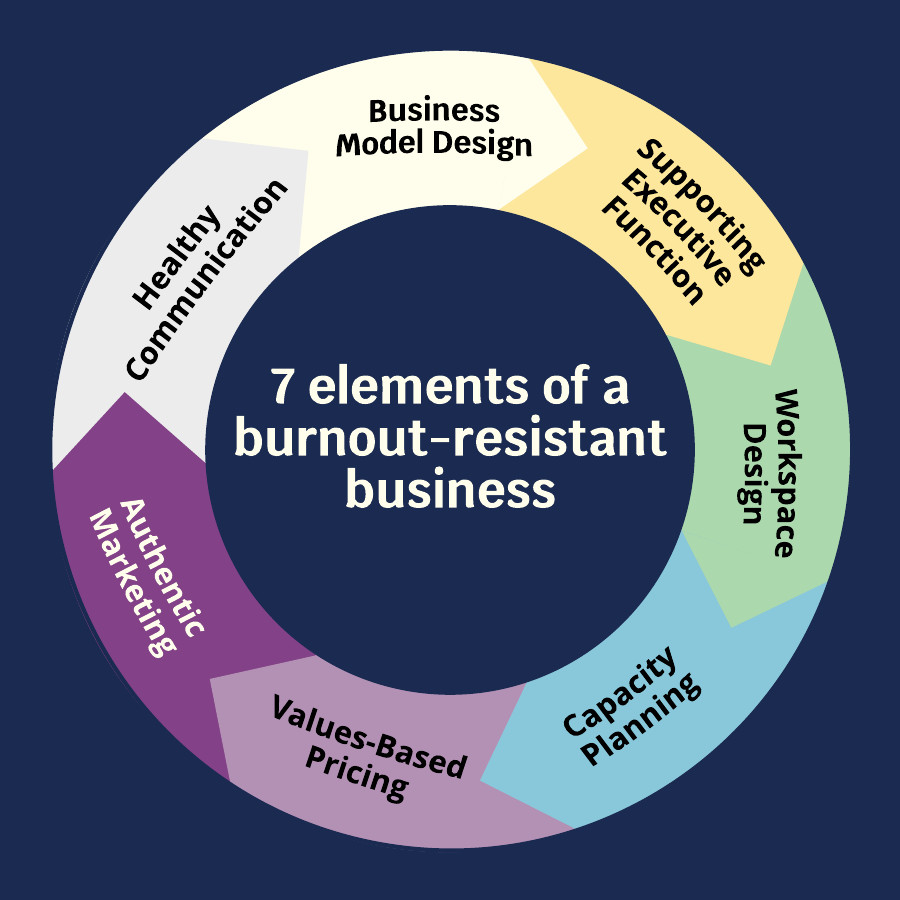
When you design your business model to fit your real capacity and goals → you can build in the executive function supports that will lead to that outcome → which frees up your cognitive load, so your brain feels better → so you can notice what’s in your environment that’s sucking your energy, and create a sensory-friendly workspace → which gives you energy back so you can have a better sense of your realistic capacity → which lets you price based upon hard data → so you can market authentically → which attracts the right clients and builds trust with them, so client communication and boundaries get easier.
Each element supports the next. This is the alchemy.
The program
I’m teaching this in a 7-week program, starting May 2nd.
You’ll learn: Business Model Design, Supporting Executive Function, Workspace Design, Capacity Planning, Values-Based Pricing, Authentic Marketing, and Healthy Communication.
Plus you get lifetime access to recordings, human-edited transcripts, templates, spreadsheets, and behind-the-scenes access to my actual business systems—so that you can see what this looks like in a real neurodivergent-run business. And there’s a way to ask questions asynchronously if the live meeting times don’t work for you.
And if you want extra support, I’m offering an optional, eight month long incubator, where you can bring your actual business questions and get answers. It’s the “yeah, sounds good, but what about my situation?” part.
Building your business
Whether you learn this from me or figure it out another way, I believe you can build a business that works for you.
If my approach resonates, I’d love to support you.
You can learn the formula in 7 weeks, instead of spending years figuring it out the hard way (like I did).
Find all the details at autismchrysalis.com/alchemy.
Wishing you a neurowonderful day.
2 Responses
The shame cycle from applying neurotypical frameworks is the thing nobody talks about. You don’t fail because you’re lazy — you fail because the system assumed a brain you don’t have. I’ve been building around this same premise: what if the tool asked how you were doing before it told you what to do? Capacity first, everything else second.
Yes, absolutely! Capacity has to come first. If you don’t have the capacity, it doesn’t matter how good your intentions or how good of a plan it is or how well it’s worked for other people, you’re not gonna be able to do it.