
How to make your business burnout-resistant and sustainable, in a way that works WITH your brain—without sacrificing your health, integrity, or profit.
Whether it’s your primary income or something you’re building on the side…
Learn the formula in 7 weeks instead of spending years figuring it out the hard way.

If you’re Autistic or AuDHD and work for yourself, and are exhausted from trying to make your business work when your brain, energy, or health doesn’t always cooperate with what you want—this is for you.
I’ve created a program called Alchemy that teaches you how to build a sustainable, burnout-resistant business that works WITH your brain—without sacrificing your health, integrity, or profit.
Here’s what I see in just about all of my self-employed clients: they’re stressed, exhausted, and blaming themselves for not being able to do all the things required to run a business.
Which particularly hurts, because they weren’t cut out for “normal” jobs, either, which is why they started working for themselves, or are in the process right now of starting a business that they hope will someday replace other income.
In some ways it is better, and they love working for themselves, but in some ways, it’s also really, really hard. And they’re wondering if they’re fundamentally not cut out for…working at all. Or even if there’s no place in this world for them.
And I get it. I’ve been there. I’ve worked for myself for almost 20 years, and run five businesses. And I’ve learned from each one, and this one, finally, has kept me out of burnout, while working full-time, for six years now. And I have more energy now than when I started.
But not by following standard business advice. In fact, I’ve had to unlearn a lot of that. It’s no wonder that you’re struggling, because everything we’ve ever been taught about business, both standard self-employment advice, and all the businesses you’ve ever worked for, tells you to be consistent, network constantly, hustle harder, put yourself out there, just sell.
But for neurodivergent brains? That advice creates a predictable cycle: push hard → burn out → guilt → self-blame → repeat.
Let me translate what that advice really means for us:
“Be consistent” actually means setting unrealistic goals that our irregular capacity makes impossible, which creates shame and the stress of it makes executive dysfunction worse.
“Network” means exhausting yourself with masking, followed by either shame at wasting your time or dread of the work that you just created for yourself.
“Hustle” means pushing past body signals, making it harder to rest, and making sensory overwhelm worse.
“Put yourself out there” means triggering complex relationship traumas, and not wanting to be perceived, leading to resistance and avoidance.
And “just sell” means rationalizing your qualms about pushy sales tactics, until you feel stuck, overwhelmed, and just want to hide.
Now ask yourself: is anyone in that state going to build a successful business?
Of course not.
But there is another way.
There are 7 key elements to building a burnout-resistant business. And when you set up systems that work, and structure them in a specific order, each one supports and leads to the next.
So you’re not relying on willpower to rest, or values to avoid desperate sales, or brain fog to make good decisions.
The system itself prevents burnout—because it’s built that way from the beginning.
When you design your business model to fit your real capacity and goals → you can build in the executive function supports that will lead to that outcome → which frees up your cognitive load, so your brain feels better → so you can notice what’s in your environment that’s sucking your energy, and create a sensory-friendly workspace → which gives you energy back so you can have a better sense of your realistic capacity → which lets you price based upon hard data → so you can market authentically → which attracts the right clients and builds trust with them, so client communication and boundaries get easier.
Each element supports the next. This is the alchemy.
I’m teaching this in a 7-week program, starting May 2nd.
You’ll learn: Business Model Design, Supporting Executive Function, Workspace Design, Capacity Planning, Values-Based Pricing, Authentic Marketing, and Healthy Communication.
Plus you get lifetime access to recordings, human-edited transcripts, templates, spreadsheets, and behind-the-scenes access to my actual business systems—so that you can see what this looks like in a real neurodivergent-run business. And there’s a way to ask questions asynchronously if the live meeting times don’t work for you.
And if you want extra support, I’m offering an optional, eight month long incubator, where you can bring your actual business questions and get answers. It’s the “yeah, sounds good, but what about my situation?” part.
Whether you learn this from me or figure it out another way, I believe you can build a business that works for you.
If my approach resonates, I’d love to support you.
You can learn the formula in 7 weeks, instead of spending years figuring it out the hard way (like I did).
Find all the details at autismchrysalis.com/alchemy.
Wishing you a neurowonderful day.
The meaningless meetings, the guess-the-subtext game of Slack comments, working on other people’s timelines, and productivity expectations that feel like an insult to how you actually function.
You traded the inflexibility of a corporate job for the pressure of having it all rest on your shoulders.
If you still have a day job, and are trying to build your business to replace it, the doubts resurface daily. Right about when your soul-sucking workday ends and you’re drained and just want to curl up and binge watch something and go to bed. But your head is pounding, your stomach is screaming, the dog needs to go out, and the dishes are piling up.
How are you ever going to build this thing up enough to replace your salary?
And if you quit to work on it full-time, that adds a ton of pressure to make it profitable before your savings runs out.

That’s not your fault.
Because the best advice you’ve found tells you to:
If you start your own business without an explicit, alternate strategy for how to build a brain-friendly business, you end up replicating the very thing you're fleeing.

Here’s what those standard business messages really mean for neurodivergents:
Setting unrealistic goals that irregular capacity makes impossible, creating shame. As stress compromises brain function, executive dysfunction and brain fog follow.
Triggers CPTSD, imposter syndrome, and bad feelings around being perceived.
Exhausting masking followed by either shame at wasting your time or dread of the work you’re now in for.
Pushing past body signals, making rest and recovery harder, and sensory overwhelm worse.
Rationalizing your qualms until cognitive dissonance triggers overwhelm, destractability, perfectionism, hiding, and feeling “stuck.”
People-pleasing and masking until you have nothing left.
And that was by design.
Because the people who gained money, status, and power from the capitalist system are, behind all their posturing and bluster, scared of people who are “different” succeeding.
That’s why every piece of standard business advice assumes infinite capacity, a neurotypical brain, and no trauma.
Because that filters out a majority of the people “They” don’t want to succeed.
So that you blame yourself, and give up, and go back to making them money, or hiding, instead of questioning if there’s another way. And maybe even succeeding.
It’s not that standard advice can’t work. But it’s only one very narrow path. And it’s wrong for your brain.
For when you have a whole team, or passive income stream, working for you.
And even ethical business advice implicitly relies on you having the willpower to avoid pushy sales tactics, or say no when a client asks for too much, when you’re desperate for money.
That's not your personal failing. Because you were never taught how to do it differently. Or that a different way was even possible.
They build on each other so that burnout becomes nearly impossible—because the system itself prevents you from getting to that point, and self-corrects.
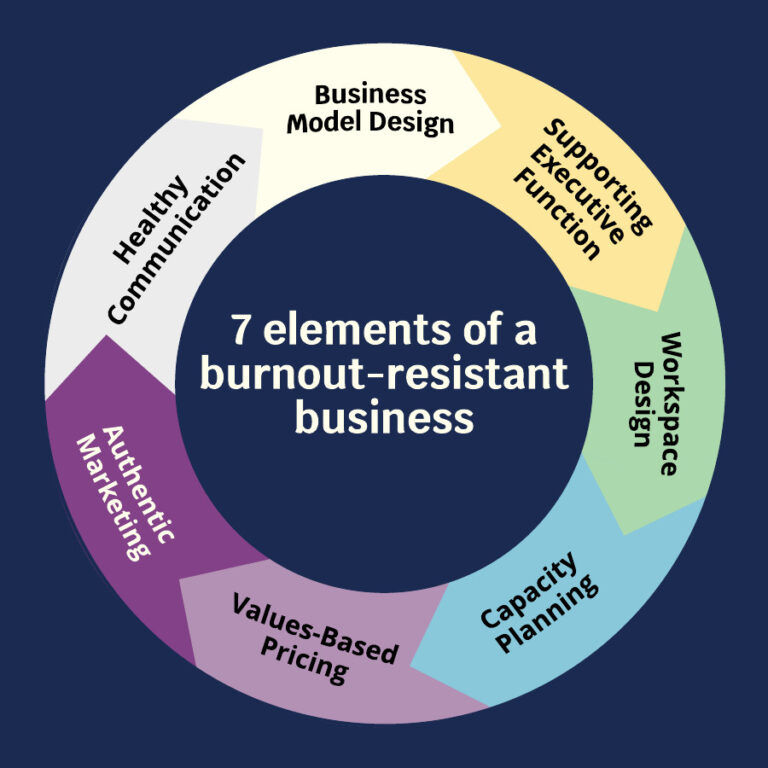
→ When you intentionally plan how your business operates, what you’re offering, and how, to account for your real needs and capacity, it will bring about the outcomes you actually want.
→ When you know what you’re aiming for, you can design executive function supports that fit your real goals, and take the load off your brain.
→ When your brain is freed up, you can think better about (everything, including) what in your environment is draining your energy, and come up with options for improvements.
→ When you feel good in your workspace, you will be in a clearer place to be realistic (neither negative nor overly-optimistic) about how much you can, and want to, actually work, and schedule your work time to include rest and life.
→ When you know how much you can realistically expect to work, you can price based on what you actually need to bring in, to maintain your chosen business model.
→ When your pricing is solid, you won’t apologize for offering your services, and can market authentically.
→ When your marketing is authentic, it attracts the people who will love what you have to offer, and builds trust, and client communication gets easier.
→ When you have better relationships with your clients, it’s clearer what parts of your business energize you, and you refine your business model.→
→ → →
And when a shiny new project idea comes along, you’ll check it against your business model, and this time your capacity planning will stick.
When combined in the right order, they transform struggle into sustainability.
Then you’re not relying on good intentions to rest, values to avoid desperation-sales, self-flagellation to promote your offers, or foggy memory to avoid bad decisions.
It’s built so you don’t get to the point where push comes to shove.
Whether you learn from me or figure it out another way, I believe you can build a business that works for you.
I’ve got a particular take on it, and if my style resonates with you, great. But either way, I wish the best for you and your business.
This is about doing what actually works, rather than blaming yourself for not getting the promised results when it wasn’t ever going to work in the first place.
So why am I teaching business?
Here’s what keeps happening: Many of my coaching clients have either left traditional employment or are trying to—they’re working for themselves, but are stressed and struggling.
And a huge part of creating a sustainable, autism-positive life when you’re self-employed? Making your business actually work without destroying you.
I’ve been steeped in it since I was eight years old, when my parents started their own business and involved me from day one.
My dad—undiagnosed Autistic—preached self-employment like it was his calling. He taught me business methodology the way other parents teach manners. How to calculate costs of goods sold. How to price out a job. How to answer objections in sales. How to treat customers ethically and respectfully.
My dad preached self-employment like it was his calling. He taught me business methodology the way other parents teach manners.
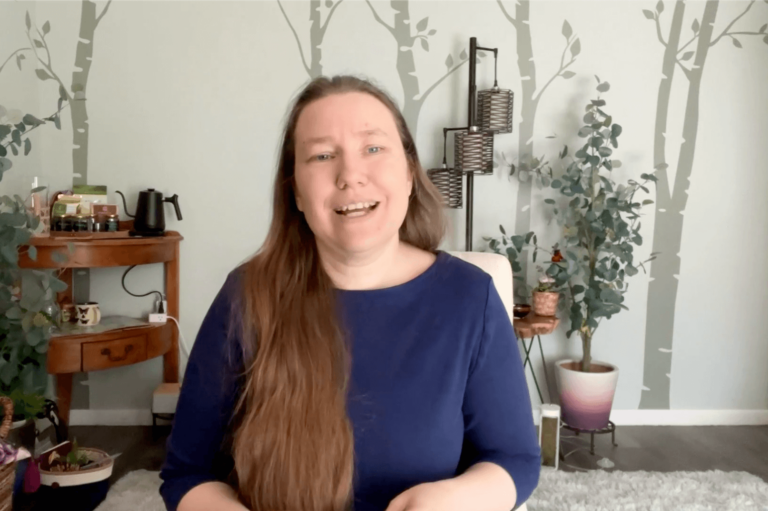
Selling address labels and Girl Scout Cookies. Treating babysitting as a business. Pitching him my services stuffing envelopes for their direct mail campaigns.
My mom—undiagnosed ADHD and highly sensitive—taught me the operations side, answering phones and talking to customers, bookkeeping, supporting our employees, keeping everything and everyone together.
When he died from cancer and we sold the business, I was in my twenties. Two years later, in 2006, I started my first official business—a small publishing company.
I wanted to make him proud of me and to honor what he’d taught me, by proving I could do it too.
I remembered all his lessons about the practicalities of business.
Instead, I listened to standard business advice. Hustle. Goals. Productivity.
I dove into traditional business education—accounting classes, sales seminars, direct marketing gurus like Jay Abraham, and hundreds (literally) of business books.
I pushed myself to work late countless nights, lying on my living room floor, exhausted, red eyes burning, staring at my laptop.

A completely life-collapsing, major burnout. The worst I’ve ever had, before or since.
Standard business advice can work. Technically. Some people make money following it.
But it was destroying people like me.
I paid close attention to what felt good and what worked better for my brain and body. I questioned everything, deconstructing the messages about “the way business works”
I sought out mentors with non-standard perspectives who were decolonizing business. I’ve invested over $35,000 in courses, programs, and mentorship on sustainable business, trauma-informed approaches, and neurodivergent-friendly practices.
I grew the business (and my working hours) slowly.
That I could stop before pushing too hard. That I could find solutions that reduced my workload. That taking longer was okay.
Let me tell you, I struggled with some intense trust issues around that.
It’s not perfect—I’m still tweaking things—but it genuinely supports my life and feels good 90% of the time.
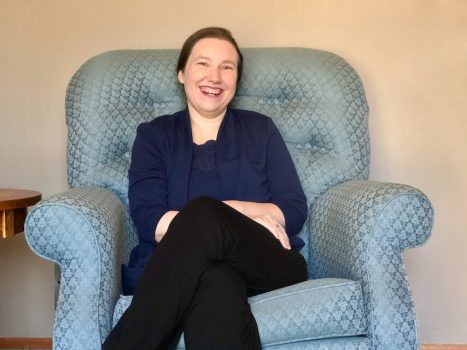
I've been self-employed in this business for 6 years without burning out at all. And I have MORE energy now than when I started. And it fully supports both me and my mom.
Every time I needed to do something in my business, I started with practical business foundations—pricing, sales, marketing, operations—then questioned how it’s “supposed” to be done. I kept what was useful and reinvented the rest.
It’s not magic—it’s alchemy. The right elements, in the right order, transform your business into:
→ One that builds sustainability into the foundation instead of treating it as a luxury you can afford once you’re “successful enough.”
→ One that explicitly designs for neurodivergent brains from day one.
→ One that acknowledges other things matter, too—so when big world events happen or your life erupts, the structures already in place let you tend to your soul and the people you care about.
To have it feel good in your life. To build up your energy reserves. To feel confident you can keep this up for as long as you choose.
My hope is that this course will save you hundreds of hours and thousands of dollars of trying to figure this out on your own.
That this will pay off exponentially—in money, energy, capacity, and actually enjoying your work, for as long as you choose to continue.
And I’ll bet you can cut through the crap to identify what’s really going on and solve it—not the pandering solution that sounds good but basically leaves you hanging. The actual thing that works.
And that solution, and your unique perspective, are gold.
Even if your business doesn’t feel world-changing, I’ll bet you do a good job with the thing that you’ve promised people you would do. And that you’re doing it in a way that treats people well. Because you know what it’s like when those don’t happen.
Deep down, that’s all my dad wanted for me—to do good in the world, and to be happy. And he saw self-employment as the best way to do both. It doesn’t have to be huge to matter. My small coaching practice is making a real difference in real people’s lives.
I know he’d be proud of that.

I’m the kind of person who needs to understand how something works.
It starts with unlearning the neurotypical business rules that were never built for us—then building systems and strategies that fit how our brains actually work, and putting them into practice in your actual business.
There’s one “right” way to do business, and if you can’t make it work, the problem is you.
Different business models serve different brains, energy patterns, capacity levels, and goals. What works for others might be actively burning you out.
“Just be consistent!” is the gold standard for business success.
No living thing is absolutely consistent day in and day out. There are variable cycles of energy from day to day, across seasons and years and times of life. And neurodivergent brains need even more freedom to work their best.
“Professional” means ignoring your body’s needs, powering through, and looking a certain way.
Your sensory environment directly impacts your capacity to work. Ignoring sensory distractors and/or overwhelm costs energy and leads to burnout.
“Work harder.” “Work longer.” “Push through.” “You can rest when you’re dead.”
Pushing past your capacity doesn’t make you more productive. It makes you burned out. And then you can’t work at all.
“Charge what you’re worth.” (That’s B.S. Your worth is infinite.) And the double-whammy of being shamed by your own marginalized group for charging anything.
Pricing has nothing to do with your worth as a human. It’s a straightforward business calculation.
“Put yourself out there!” ”Build your personal brand!” “Be visible!” And “you need to push through your qualms about selling” to do things that make you cringe.
What needs to be visible is the thing you’re offering, not you. And the best marketing feels good to both you and your potential clients, builds trust, and forms positive relationships that last long-term.
“The customer is always right.” “Be available whenever they need you.” And, “never say no or you’ll lose clients.”
Healthy boundaries make you a better service provider. Clients who can’t respect reasonable boundaries will push you towards burnout. And there are plenty of clients who can!
If you would benefit from continued support, answers, and regular check-ins as you build these new systems…
Help figuring out the kinks of adapting theory to your unique situation…
And/or want to build positive connections with other neurodivergent entrepreneurs…
Small enough that you’ll get personalized support and answers to your specific questions.

(Even if you couldn’t put words to it?)
Someone who can pass on a new shiny marketing idea—because you already have a plan that works.
Instead of taking every client, project, gig, or opportunity—because you’re scared about money—you’ll check each one against your business model. And that will keep work within your actual capacity.
Instead of convincing yourself you want to do something when you’re really just doing it for the money, you’ll know what lights you up, what gives you energy.
And you’ll have the pricing and systems in place to go after more of that—and to say no to the tempting distractions.
When something goes wrong, you pause, notice the anxious voices—and also know the truth: it’s going to be okay.
When you’re tired, or have a chronic pain flareup, you actually rest. Without ruminating. Because your business is designed for variable energy and capacity.
When a client asks for too much, you set boundaries without guilt—because healthy boundaries make you a better service provider, and the structures are already in place to support that.
When world events happen or your life erupts, you can tend to your soul and the people you care about—because the business can handle it.

Someone who’s done with “power through” or “push past” or “just be consistent.”
That version of you? The one who’s not scared about money all the time? The one whose nervous system has learned that work doesn’t have to mean suffering?
When you're building a house, the stronger the foundation, the more it can hold. The more it can withstand. The longer it will last.
And in your business, when you build the systems—the foundations—to hold you, everything changes.
If you’re wondering how much time it will take, set aside two hours for the session, and 1-3 hours of reflection/implementation scattered throughout your week.
That being said, it’s totally flexible—attendance is optional (all meetings will be recorded), so you can do it when your brain works, not on someone else’s schedule.
Camera off is okay.
Sign up now to join AuDHD Alchemy
7 Saturdays, May 2nd – June 13th, at 2pm ET | 7pm BST
Can’t attend live?
Submit questions asynchronously and get personalized answers.
$1500 USD
Pay in full or in 5 monthly payments of $300.
(No surcharge for the payment plan. Yay!)
Extended payment plan available upon request. 
Sign up now to join AuDHD Alchemy

My goal is for this to help you build your business so it works with your real life and goals, and avoids burnout.
It’ll take time and input on your part to make the structural changes we will be talking about, a little at a time, and to course correct as necessary, but I truly believe that this will help.
But if it doesn’t, I don’t want you to be out the money.
So here’s my promise to you:
Basically, if you sign up and don’t use the course, that’s on you. But if you give it a fair shot and it doesn’t actually help you, that’s on me. Is that fair?
To make the structural changes that will really be needed to make your business burnout-resistant, it’s going to take longer than seven weeks.
But I expect that you’ll be able to tell within that time whether you’re on the right track, and feel tangible improvements.


 )
)
Sign up now to join AuDHD Alchemy